
The 2026 Cryptographic Cliff: Why Your Codebase Needs an Audit-Ready CBOM Today
- Ramkumar Sundarakalatharan
- Apr 12
- 3 min read

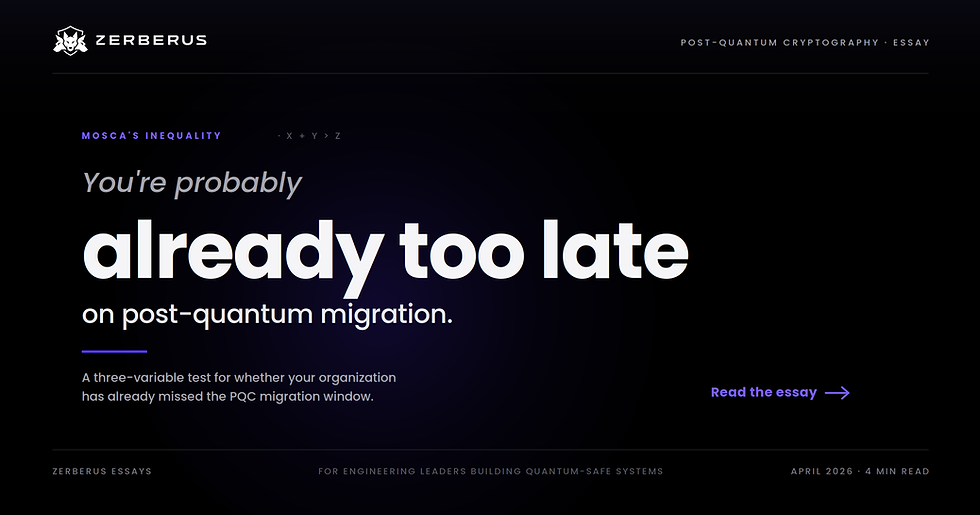
The year 2026 has marked a fundamental shift in the digital landscape. We are no longer living in the "wait and see" era of cybersecurity. Between the finalisation of NIST’s Post-Quantum Cryptography (PQC) standards and the strict enforcement of the EU Cyber Resilience Act (CRA), the industry has hit a regulatory and technical "cliff".
For the modern developer, the message is clear: if you cannot map, measure, and prove the strength of your encryption, you are building on borrowed time. At Zerberus.ai, we believe the solution isn't more cloud-based surveillance of your code; it is Sovereign Cryptographic Governance.
To achieve this, you need a Cryptographic Bill of Materials (CBOM).
Beyond the SBOM: Securing the Cryptographic Supply Chain
For years, Zerberus.ai has championed a more transparent, open-source approach to security. We previously open-sourced our Risk-Aware Metadata scanning to relieve the industry from its over-dependence on the flawed CVE/NVD system. We proved that understanding the context of your software supply chain is more important than simply ticking a box on a vulnerability list.
Today, we are bringing that same fervour to cryptography.
While a Software Bill of Materials (SBOM) tells you which libraries you use, it is often silent on how those libraries protect your data. A Cryptographic Bill of Materials (CBOM) is the essential evolution. It uncovers the hidden "black boxes" of encryption buried deep within your dependencies.
Why the "Inventory First" Approach is Mandatory:
The Post-Quantum (PQC) Reality: With NIST's ML-KEM and ML-DSA standards now active, the "Harvest Now, Decrypt Later" threat is no longer a theoretical exercise—it is a live risk for any data with long-term sensitivity.
Regulatory Enforcement: In the UK and EU, NIS2 and the CRA now place board-level liability on cryptographic governance. "State-of-the-art" protection is now a legal requirement, not a suggestion.
"The risk is not only weak cryptography, but a fragmented transition that breaks interoperability or leaves critical sectors moving at different speeds." — NCSC/ENISA Joint Advisory on PQC Readiness (2026)
Sovereign Cryptography: The Strategic Rise of Guomi (SM3/SM4)
A key part of securing your cryptographic supply chain is achieving Algorithmic Agility. Relying on a single set of standards creates a "cryptographic monoculture." If a fundamental flaw is discovered in the AES structure today, most global systems have no immediate fallback.
This is why the strategic evolution of the Guomi suite, specifically SM3 (hashing) and SM4 (block cipher) is so critical. These are no longer regional curiosities; they are ISO/IEC-recognised standards that provide a vital alternative to NIST-centric stacks.
True governance means having the visibility to manage Sovereign Cryptography alongside PQC, ensuring your application is resilient across different geopolitical and technical landscapes.
The Privacy Paradox: Why Local-First Analysis Matters
Most "Enterprise" security tools require you to clone your proprietary source code and upload it to their cloud for analysis. This creates a massive privacy paradox: to "secure" your code, you must first leak your most valuable intellectual property.
As a joint factsheet from CISA, NSA, and NIST recently highlighted:
"An organisation cannot protect or upgrade what it doesn't know it has. Creating a cryptographic inventory is the foundational step toward crypto-agility and quantum readiness." — CISA/NSA/NIST Joint Factsheet on Quantum Security
We believe you shouldn't have to sacrifice privacy for visibility.
Introducing ZCBOM: The Open-Source VS Code Extension
ZCBOM by Zerberus.ai is our latest commitment to the open-source community. It is a developer-first tool designed to automate your cryptographic inventory without your code ever leaving your machine.

Strategic Advantage of ZCBOM
How ZCBOM Works: From Code to Governance
ZCBOM is designed for developers, not academics. It turns complex cryptographic requirements into actionable insights:
Identify the Primitives: ZCBOM scans your code and dependencies to find hard-coded keys, weak hashing (MD5/SHA-1), and legacy curves.
Score the Risk: It maps your inventory against NIST PQC, ENISA, and Guomi standards.
Generate the CBOM: With one click, you produce a standardised report that meets auditors' requirements and ensures your "Cryptographic Supply Chain" is fully documented.
Take Control of Your Cryptographic Destiny
The era of "set and forget" encryption is over. Whether you are migrating to PQC, integrating Sovereign Cryptography, or simply trying to stay compliant with the EU CRA, visibility is your only defence.
Stop guessing. Stop leaking your code to the cloud. Start governing.
Join the ZCBOM Waitlist Today
We are inviting a select group of developers to be the first to access the ZCBOM VS Code extension. Experience the power of a fully open-source, local-first cryptographic audit tool.
👉 [JOIN THE ZCBOM WAITLIST – SECURE YOUR ACCESS]
Open Source. Local-First. Quantum Ready.


Comments