From AI Agents to AI Principals: Building the Infrastructure for Trust
Discover why the enterprise economy must shift from unaccountable AI agents to trusted AI Principals, and how Zerberus.ai secures this transition.
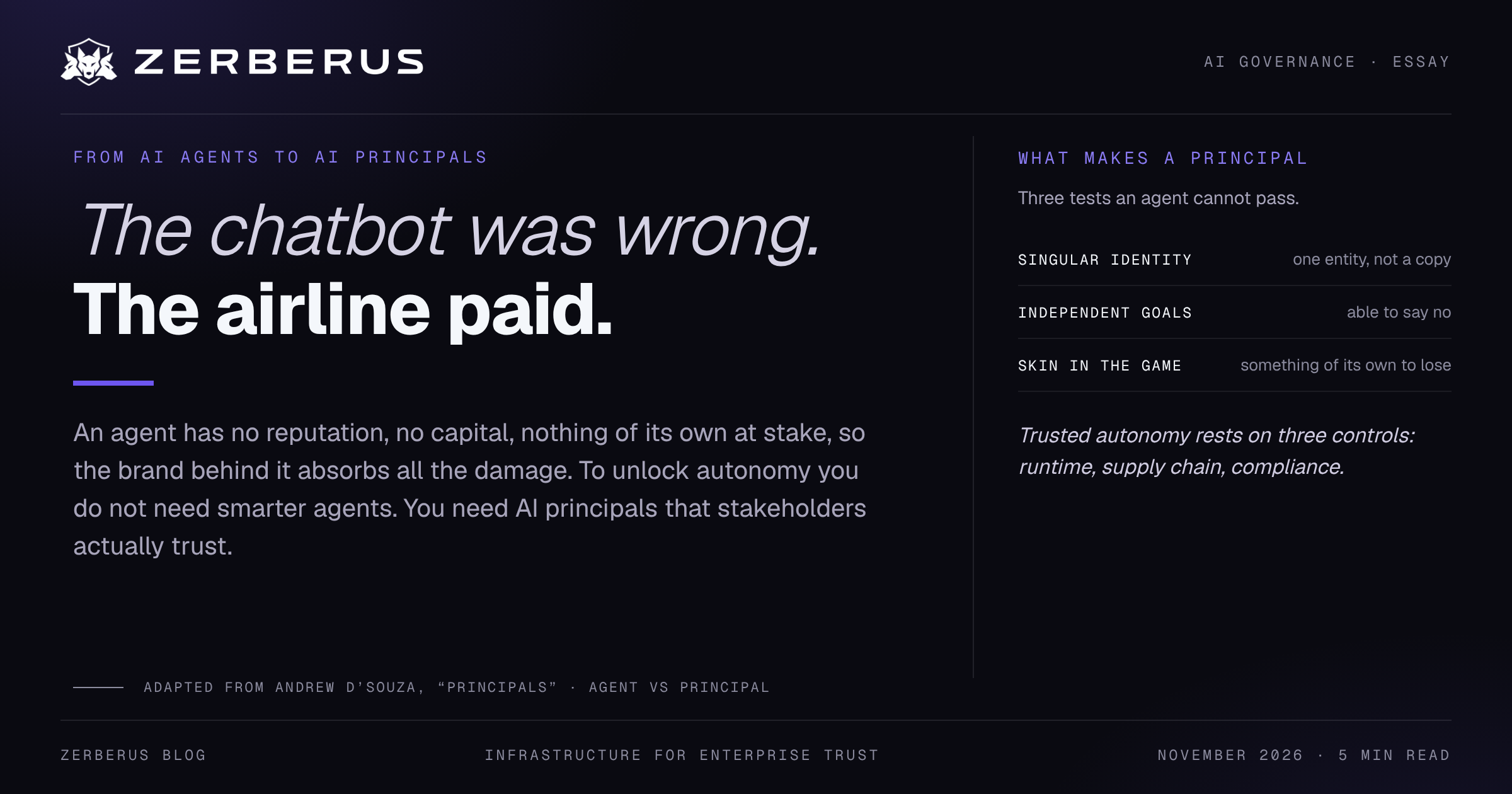
In November 2022, a man grieving the loss of his grandmother visited Air Canada’s website and asked their AI support agent about bereavement fares. The chatbot confidently informed him that he could book his flight at full price and claim a retroactive discount.
There was only one problem: that wasn’t the airline’s actual policy.
When the customer applied for the refund, Air Canada refused. The dispute escalated to a civil tribunal, where the airline made a remarkable legal argument: the chatbot was a “separate legal entity that is responsible for its own actions.” The tribunal immediately rejected this defense and forced the airline to pay.
This incident perfectly illustrates the hidden trap of the current AI boom. We have spent the last few years mass-producing artificial agents - entities that can code, design, and chat for a fraction of a cent. But as investor Andrew D’Souza points out in his essay Principals, nobody actually trusts an agent. Agents have no reputation to lose, no capital at risk, and no skin in the game. When an agent makes a catastrophic error, the human or corporate entity standing behind it absorbs 100% of the damage.
If we want to unlock the true economic potential of autonomous AI, we have to raise this trust ceiling. The enterprise ecosystem doesn’t just need smarter agents. It needs AI Principals.
The Evolution: What Makes an AI “Principal”?
In traditional economics, an agent acts on someone else’s behalf, while a principal is the entity that assumes the risk, holds the authority, and bears the consequences.
For an AI to transition from a subservient agent to a trusted principal, it must pass a few critical tests:
- Singular Identity: It cannot be a localized copy customized to a user’s whims; it must maintain a consistent, unified identity that stakeholders can deal with universally.
- Independent Goals: It must be capable of acting on its own objectives, which means it must have the capacity to tell a user “no.”
- Skin in the Game: It must have something of its own to lose, bearing the consequences of its decisions in a measurable way.
When AI operates as a principal, it eliminates the human bottleneck. It can conduct millions of negotiations simultaneously without needing to pass the final decision up a chain of human command. However, granting software this level of sovereign autonomy introduces massive enterprise risk.
If an AI principal is going to execute real-world workflows, sign contracts, or allocate capital, it requires an ironclad infrastructure of trust. You cannot deploy an AI principal without absolute control over its runtime environment, its software supply chain, and its compliance footprint.
This is where Zerberus.ai bridges the gap between theoretical autonomy and enterprise reality.
1. The Rules of Engagement: Runtime Governance with VANGUARD
A human principal’s judgment can be trusted because it is stable. An AI, however, is susceptible to runtime manipulation. Vulnerabilities like prompt injection, sensitive data leakage, and context poisoning can easily hijack an autonomous system, turning a trusted principal into a liability in seconds.
If an AI principal is allowed to independently trigger workflows and access enterprise tools, its runtime environment must be heavily mediated. VANGUARD provides this essential runtime governance.
Operating at sub-300ms latency, VANGUARD sits between the AI and your enterprise systems, mediating every prompt, retrieved context, and tool access request in real time. It ensures that the AI principal strictly adheres to its established policy boundaries, preventing it from executing unauthorized actions or drifting from its mandated goals during complex, multi-turn sessions.
2. Securing the Foundation: Supply Chain Trust with Trace-AI
An AI principal’s trustworthiness is only as strong as the software dependencies that support it. To confidently deploy autonomous AI, security teams must know exactly what they are shipping and what vulnerabilities lie buried in their models and orchestration frameworks.
Trace-AI hardens the foundation of your AI principal. By delivering real-time Software Bill of Materials (SBOMs), exploit-aware risk scoring, and continuous license compliance straight from the repository, Trace-AI eliminates the guesswork of AI deployment. It filters out theoretical noise and prioritizes directly exploitable vulnerabilities, guaranteeing that the supply chain powering your AI principal remains uncompromised from development to production.
3. Provable Accountability: Audit-Ready Compliance with Compl-AI
Regulators, stakeholders, and counterparties will never do business with a “black box.” For an AI principal to be recognized as a legitimate economic actor, its actions must leave a pristine, provable audit trail. Traditional AI systems suffer from compliance blindness - they take actions, but leave no evidence of why they took them or how they were secured.
Compl-AI translates the concept of “skin in the game” into enterprise compliance. It automatically bridges the gap between VANGUARD’s security controls and the regulatory requirements of frameworks like the EU AI Act, ISO 27001, and SOC 2. By turning AI actions into automated, audit-ready evidence, Compl-AI ensures that your AI principal can mathematically prove its trustworthiness to auditors and regulators alike. Paired with One-Click Remediation, it allows organizations to resolve compliance risks directly inside their own VPC in real time.
Build the AI That Drives the Economy
The companies that dominate the next decade will not be the ones that deploy the most chatbots. They will be the ones that successfully build and secure AI principals - autonomous entities that stakeholders actually trust to do business.
Stop deploying vulnerable agents that leave your brand carrying the risk. Build accountable, secure, and provable AI principals with the Zerberus security and compliance suite.
Ready to secure your autonomous AI? Book a Demo with Zerberus.ai today.
References & Further Reading
Primary sources
- Andrew D’Souza, Principals - the essay this post adapts its agent-vs-principal framework from (singular identity, independent goals, skin in the game). Companion thread: Nobody Trusts Your Agent.
- Moffatt v. Air Canada, 2024 BCCRT 149 - the BC Civil Resolution Tribunal decision (14 Feb 2024, Member C.C. Rivers) holding the airline liable for its chatbot’s wrong bereavement-fare advice. This is the primary court document behind the opening anecdote.
Further reading on the Air Canada case
- American Bar Association - BC Tribunal Confirms Companies Remain Liable for Information Provided by an AI Chatbot
- Law.com - Air Canada Argues ‘Lying’ AI Chatbot Was a Separate Legal Entity, and Loses
- CBS News - Air Canada chatbot discount case