Best AI Runtime Security Platforms in 2026: 6 Compared
Comparing VANGUARD, Lakera Guard, Prompt Security, Prisma AIRS, Zscaler and NeuralTrust across deployment, prompt injection protection, data security, policy enforcement and agent governance.
AI applications are moving into production faster than the security controls designed to protect them. Prompt injection, sensitive-data leakage, multi-turn manipulation, and unsafe agent behavior introduce risks that traditional application firewalls were not designed to understand.
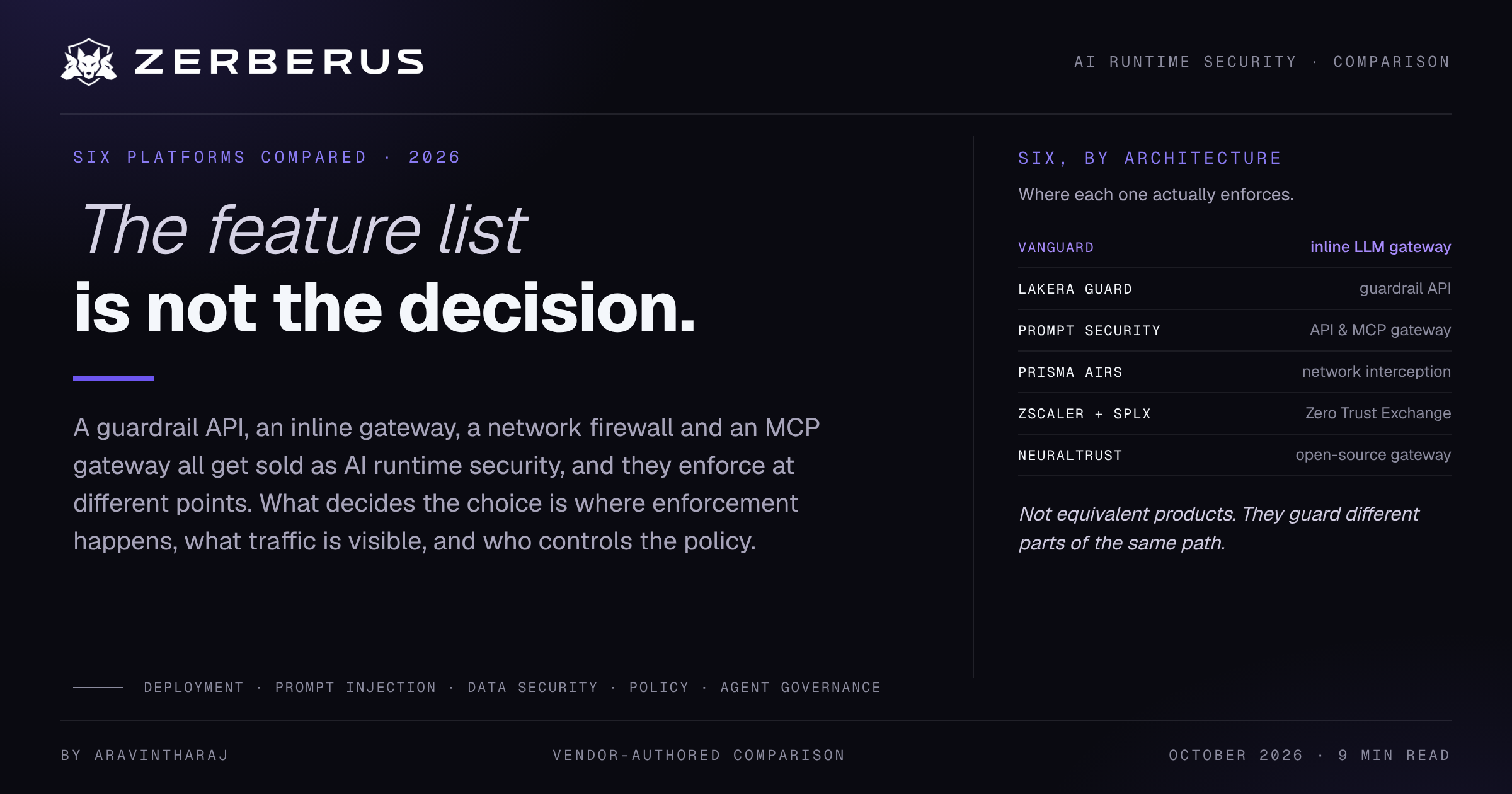
The market has responded with AI runtime security platforms, LLM gateways, guardrail APIs, and agent security products. But these approaches are not interchangeable. A guardrail API may require application-level integration. An inline gateway can enforce policies across traffic routed through it. An enterprise security platform may extend existing network controls to AI applications. An MCP gateway can govern which tools an agent is authorized to invoke.
The right choice depends less on the number of features and more on where enforcement happens, what traffic is visible, and who controls the policy.
Note: This is a vendor-authored comparison. VANGUARD is developed by Zerberus Technologies. Competitor assessments are based on publicly available product documentation as of October 2026.
AI Runtime Security Platforms: Quick Comparison
These are not necessarily equivalent products. They protect different portions of the AI application lifecycle and operate at different enforcement points.
| Platform | Runtime Architecture | Primary Strength | Deployment | Best Suited For |
|---|---|---|---|---|
| VANGUARD - Zerberus | Inline LLM gateway | Bidirectional inspection, app policies, session-aware detection | Managed SaaS | Teams securing production LLM apps with minimal code changes |
| Lakera Guard - Check Point | Guardrail API | Prompt injection and jailbreak detection | Cloud, on-prem options | Teams prioritizing specialized detection and Check Point integration |
| Prompt Security - SentinelOne | Workforce controls, API & MCP gateway | Enterprise AI usage visibility and agent access control | SaaS, on-prem options | Organizations governing employee AI usage and MCP access |
| Prisma AIRS - Palo Alto | Network and API interception | Broad enterprise AI security coverage | Public and private cloud | Enterprises consolidating AI security into Palo Alto Networks |
| Zscaler + SPLX | Zero Trust Exchange | AI discovery, governance and automated red teaming | Cloud-delivered | Zscaler customers building continuous AI security programs |
| NeuralTrust | Open-source AI gateway | LLM routing, MCP and agent governance | SaaS, hybrid, self-hosted | Teams building agent-heavy systems or needing deployment flexibility |
What Is AI Runtime Security?
AI runtime security protects applications while they interact with language models, external data sources and, increasingly, tools. Unlike pre-deployment model testing, runtime controls evaluate activity as it happens.
Common use cases include:
- Prompt injection detection: Identifying instructions intended to override application rules or manipulate model behavior.
- Sensitive-data protection: Detecting and masking confidential information entering or leaving an AI application.
- Content safety: Enforcing application policies on potentially harmful or disallowed content.
- Session-aware detection: Evaluating requests in conversational context instead of treating each message independently.
- Policy enforcement: Applying centrally managed security rules to applications and their AI traffic.
- Agent and MCP governance: Controlling tool access, execution permissions and responses from external systems.
- Auditability: Recording security decisions for incident investigation, compliance and operational review.
AI Gateway vs Guardrail API vs AI Firewall: What’s the Difference?
One of the most important architectural decisions is where the security control sits.
1. Guardrail APIs
A guardrail API evaluates content explicitly submitted by an application. For example, an application might send a user prompt to a detection API before forwarding it to the language model.
- Best for: Applications requiring selective, fine-grained integration with specialized detection services.
- The catch: Coverage depends on flawless developer integration. If a developer forgets to inspect an intermediate tool result, that interaction bypasses the guardrail.
2. Inline AI Security Gateways
An inline gateway sits between an application and the model provider. The application sends requests through the gateway, which evaluates configured policies before forwarding traffic upstream. Responses are inspected before returning to the application.
- Best for: Teams seeking consistent runtime controls across multiple applications and LLM providers without heavy code refactoring.
- The catch: A gateway protects only the traffic actually routed through it. Unmonitored direct connections remain outside its boundary.
3. Network-Based AI Firewalls
Network-based controls inspect supported AI traffic through an enterprise security infrastructure, providing central visibility without requiring separate app integrations.
- Best for: Enterprises extending existing network security investments (like Palo Alto or Zscaler) to AI applications.
- The catch: Effectiveness depends on traffic routing, protocol support, and encryption visibility.
4. MCP and Agent Gateways
MCP gateways sit between AI agents and the tools and services those agents access. They enforce which tools are available, who can invoke them, and what operations are permitted.
- Best for: Agentic applications where models interact with enterprise systems, data stores, and external APIs.
Six AI Runtime Security Platforms Compared
1. Lakera Guard - Specialized AI Threat Detection
Check Point acquired Lakera in October 2025, bringing its AI-native security capabilities into the Check Point portfolio. Lakera Guard focuses heavily on identifying malicious interactions, including prompt injection and jailbreak attempts.
- Strengths: Specialized detection research and application-level flexibility.
- Considerations: Teams must ensure prompts, retrieved documents, and model outputs are all consistently routed to the API for screening.
- Best fit: Organizations prioritizing detection quality or those already invested in Check Point infrastructure.
2. Prompt Security - Workforce AI and MCP Governance
Now part of SentinelOne, Prompt Security originally focused on visibility into employee generative AI usage. Its capabilities have since expanded to include MCP gateway controls that inspect interactions between AI apps and external tools.
- Strengths: Enterprise AI usage visibility, workforce governance, and control over MCP interactions.
- Considerations: Ensure you distinguish employee AI governance from the runtime enforcement required by customer-facing LLM applications.
- Best fit: Security teams governing workforce AI adoption and agent-driven enterprise workflows.
3. Palo Alto Networks Prisma AIRS - Broad Enterprise AI Security
Prisma AIRS combines runtime AI protection with model assessment, red teaming, and posture management. Its architecture supports both network interception and API-based integration.
- Strengths: Broad security coverage and seamless integration with existing Palo Alto Networks infrastructure.
- Considerations: Buyers should verify which capabilities are available within their specific deployment architecture.
- Best fit: Large organizations consolidating AI security controls into an existing enterprise security estate.
4. Zscaler with SPLX - AI Discovery, Governance and Red Teaming
Zscaler acquired SPLX in late 2025, expanding its capabilities across discovery, automated testing, and governance alongside Zscaler’s cloud-delivered controls.
- Strengths: Continuous evaluation, AI discovery, and integration with Zero Trust architecture.
- Considerations: Teams focused specifically on application-level LLM enforcement should evaluate the available inspection points.
- Best fit: Enterprises standardized on Zscaler investing in broader AI security governance.
5. NeuralTrust - Open-Source Gateway and Agent Security
NeuralTrust combines its TrustGate AI gateway (open source under Apache 2.0) with its TrustGuard runtime detection. It supports routing across LLM providers and MCP gateway capabilities.
- Strengths: Open-source gateway infrastructure, multi-provider routing, and self-hosting options.
- Considerations: Buyers must evaluate which protections are supplied by the open-source gateway versus the commercial platform components.
- Best fit: Agent-focused engineering teams seeking extensible gateway infrastructure and deployment flexibility.
6. VANGUARD - Inline Security for Production LLM Applications
VANGUARD by Zerberus takes a highly focused approach. Rather than requiring developers to scatter guardrail API calls throughout their codebase, VANGUARD provides an inline enforcement layer between the application and supported model providers.
- Strengths: Endpoint integration (minimal code changes), bidirectional inspection (including streaming), pass-through credentials, and Open Policy Agent (OPA) integration.
- Considerations: Currently focused on LLM traffic mediation; granular MCP tool governance is in beta.
- Best fit: SaaS, fintech, and AI product teams building production chat, RAG, and copilot applications with OpenAI, Anthropic, or Google compatible APIs.
Deep Dive: How VANGUARD Protects LLM Applications
As the developers behind VANGUARD, we want to peel back the curtain on how our specific architecture solves these problems for engineering and security teams. VANGUARD’s production capabilities focus on centralizing policy enforcement with minimal application refactoring.
Prompt Injection Detection with Layered Inspection
VANGUARD uses two detection layers to catch prompt injections:
- Pattern-based checks for recognized attack structures.
- Meta’s Prompt Guard 2 classifier for additional model-based assessment.
Detection thresholds can be adjusted per application, improving coverage across different attack patterns without blocking legitimate user workflows.
Sensitive-Data Protection in Both Directions
Sensitive information can enter an AI system through a user prompt or leak through a generated response. VANGUARD applies configurable data-protection controls to supported request and response paths, including streamed responses.
We detect and mask emails, phone numbers, payment cards, SSNs, API keys, and named entities. This ensures you aren’t exposing customer data to model providers, and you aren’t leaking internal data back to users.
Session-Aware Detection
A single malicious request might look harmless, but the complete conversation may reveal a slow-burn attempt to alter model behavior. VANGUARD evaluates requests using the conversation history supplied by the application, giving our detection logic crucial context that isolated message inspection misses.
Policy as Code with Open Policy Agent (OPA)
Detection is useless without an enforceable decision. VANGUARD uses Open Policy Agent (OPA) to evaluate application-specific rules. Teams can update policies centrally without redeploying the application. For example, one app can strictly block sensitive data, while an internal app merely logs it for review.
Auditable Security Decisions (SOC2, HIPAA, GDPR)
A useful runtime security control explains why it blocked a prompt. VANGUARD records request decisions, reasons, and risk scores. This Audit Log Explorer supports investigation across multi-turn interactions and easily integrates into enterprise SIEMs to satisfy SOC2, HIPAA, and GDPR compliance requirements.
What About Agent and MCP Security?
Autonomous agents create an entirely new enforcement problem. Prompt inspection can identify suspicious instructions, but it cannot automatically establish whether a tool invocation is authorized.
If an AI sales assistant is connected to a CRM, and a malicious prompt asks the agent to export customer records to an external server, the security questions change:
- Is the agent authorized to invoke the CRM export tool?
- Is this operation within the user’s specific permissions?
VANGUARD’s roadmap transparency: Today, VANGUARD easily inspects tool-result content through supported model traffic. Dedicated, granular MCP governance and tool-call authorization are currently in private beta and slated for general availability in early 2027. Teams requiring these capabilities immediately should look closely at NeuralTrust or SentinelOne.
6 Questions to Ask Before Choosing an AI Security Gateway
A vendor demonstration should answer more than whether the system can block a simple jailbreak. Ask these six questions:
- Where is the enforcement point? Does protection happen through a central gateway, explicit API calls, network interception, or an MCP proxy?
- Who handles the model provider credentials? Does the gateway store provider keys, pass them through, or exchange them?
- Are requests and responses both inspected? Does the platform support streaming? Can it inspect retrieved content and tool results?
- Does detection understand conversational context? Can the platform identify multi-turn manipulation?
- Can security teams govern policy independently? Can policies be updated without developer redeployment?
- What happens when the model invokes a tool? Can the platform authorize the requested operation using verified identity and resource permissions?
Frequently Asked Questions
What is the best AI runtime security platform in 2026? The best platform depends on your architecture. Lakera is great for specialized detection, Prisma AIRS for broad enterprise network coverage, NeuralTrust for open-source agent infrastructure, and VANGUARD for inline protection of production LLM apps with minimal engineering overhead.
What is the difference between an AI firewall and an LLM security gateway? An AI firewall is a broad term for controls that inspect or restrict AI-related activity. An LLM security gateway is a specific architectural approach that routes model traffic through a central inspection point.
Does an AI security gateway add latency? Inline inspection introduces additional processing overhead. The impact depends on detection models, deployment location, response streaming, and policy complexity. Always request actual latency measurements under workloads representative of your application.
Do I need to change my LLM provider to use VANGUARD? No. VANGUARD is designed to work with supported APIs from OpenAI, Anthropic, and Google. Integration typically involves changing the model API endpoint and supplying the required Zerberus header.
Evaluate VANGUARD with Your Own LLM Application
AI runtime security is easier to evaluate against real application behavior than a vendor feature checklist. You can evaluate VANGUARD using your existing test applications without changing your underlying model provider.